
LIFEPATHS
Live an entire life. The dice decide. You live with the consequences.
Fact sheet
| Title | LifePaths |
|---|---|
| Developer | Antoine Cottenier |
| Publisher | Independent / self-published |
| Country | France |
| Genre | Narrative, choice-driven life simulation |
| Platform | Web browser (desktop, tablet, mobile) |
| Languages | French, English |
| Availability | Available since August 17, 2026 |
| Business model | First trial free until age 45, then credit packs |
| Website | lifepaths.io |
| Contact | contact@lifepaths.io |
Pricing
The first trial is free until age 45. After that, three credit packs:
| Pack | Credits | Price (tax incl.) | Estimate (Prestige engine) |
|---|---|---|---|
| Discovery Existence | 500 | €4.99 | ~50 narrative decisions |
| Premium Life | 2,000 | €14.99 | ~200 narrative decisions |
| Dynastic Existence | 3,000 | €24.99 | ~300 narrative decisions |
Prestige (10 credits/decision) is the most credit-expensive engine: with the Classic engine (2 credits/decision), these figures are roughly 5 times higher.
Elevator pitch
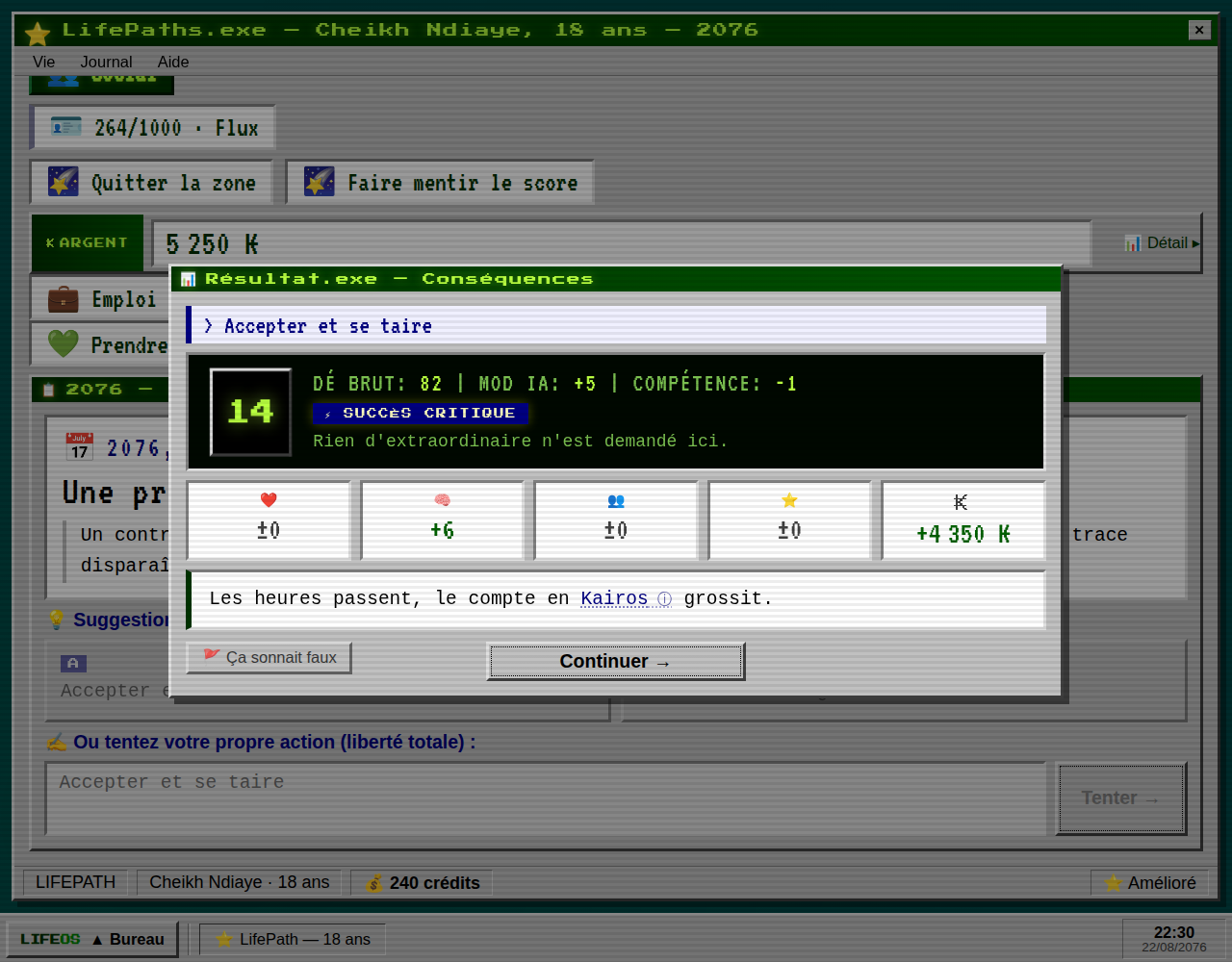
LifePaths is a narrative life simulator: you're born, and you decide everything: career, money, relationships, health. Every action goes through two checks before it counts: first its plausibility, judged by AI, then a roll of a hundred-sided die, resolved by the game's own engine. It all plays out in a 2076 dystopia, where an algorithmic score (the Civic Index) decides what you're allowed to do.
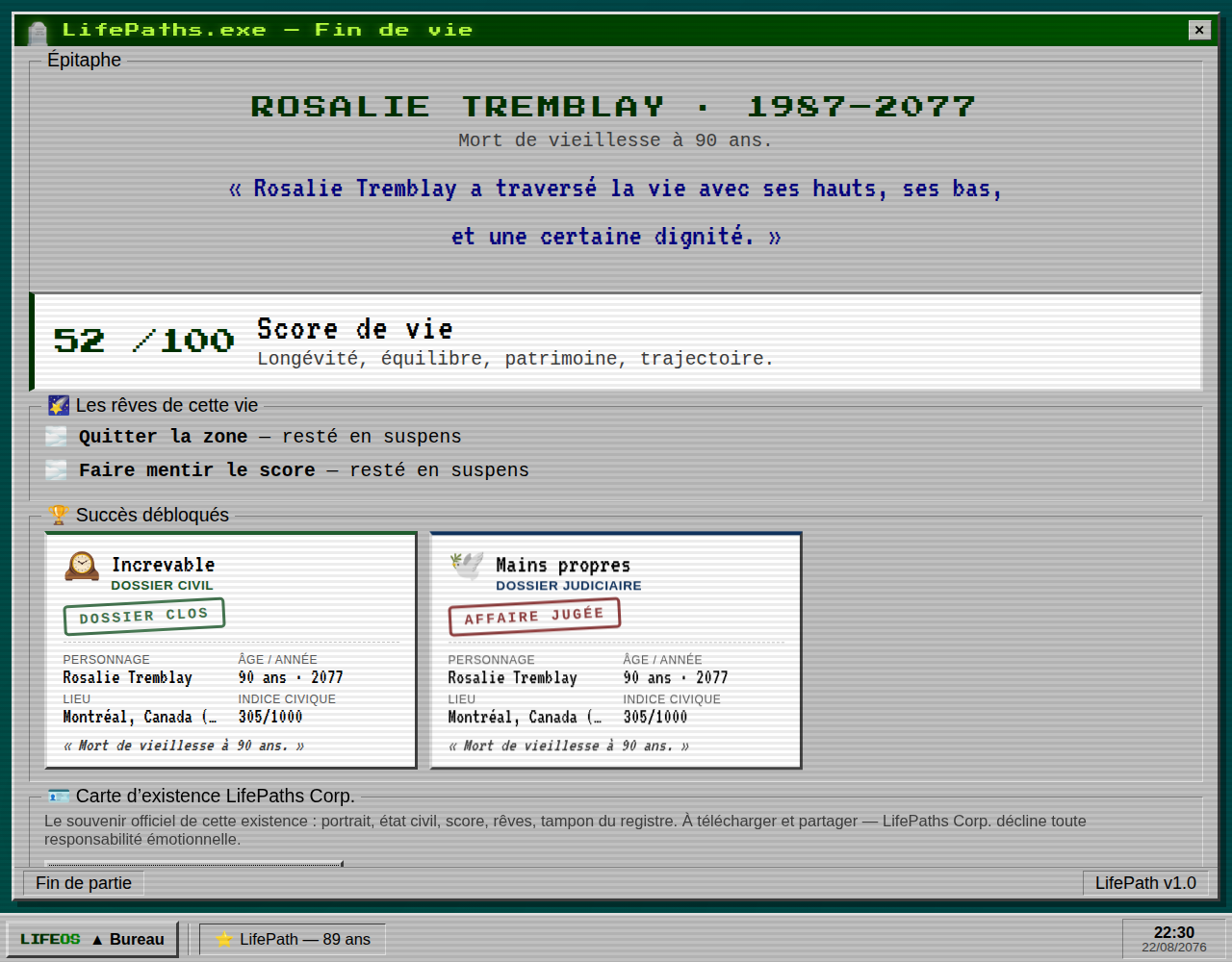
Every playthrough opens with a childhood you PLAY, not a childhood generated in one block: four childhood memories, one round at a time — a situation, a reaction (a suggestion or free text), a dice roll that decides — ending in a final round that sets the tone for the rest of the life. These rounds shape the character's traits, skills and first job, with no character-creation menu involved. Adult life follows: one to four decisions a year, resolved by the same mechanic. The player ages, works, borrows, falls ill, messages the people around them, until death... which is permanent. What's left is a life summary, a shareable card, and a lineage to carry on or a new life to start.
What sets LifePaths apart
- Live an entire existence, from childhood to death, in a single playthrough.
- A character shaped by their childhood, not picked from a creation menu.
- Free-text actions, judged before they're resolved: classified by plausibility.
- The hundred-sided die roll is always visible.
- A social score, the Civic Index, partly inherited, that opens or closes doors.
- Permanent consequences, permanent death.
- A 2076 dystopia.
- The most memorable lives can progressively enrich the game's world and be selected for the Stories page.
- Lives you've played can surface and influence other players' lives, or your own future ones.
- A childhood you PLAY, round by round, dice included — not a file generated in one block before the game starts.
- Replayability through procedural genesis — every childhood changes the character and the possible endings.
- HERMES Messenger: chat by instant message with the people in your life, right from inside the game.
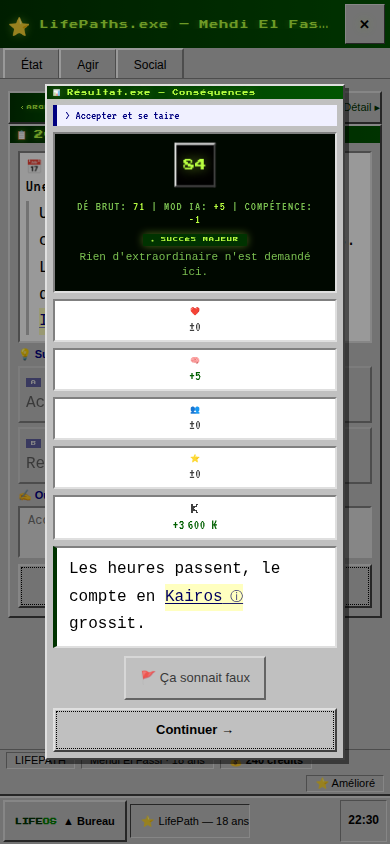
How a decision works
One rule explains why LifePaths isn't a chatbot with a UI on top: the AI classifies, the engine decides.
The world of 2076
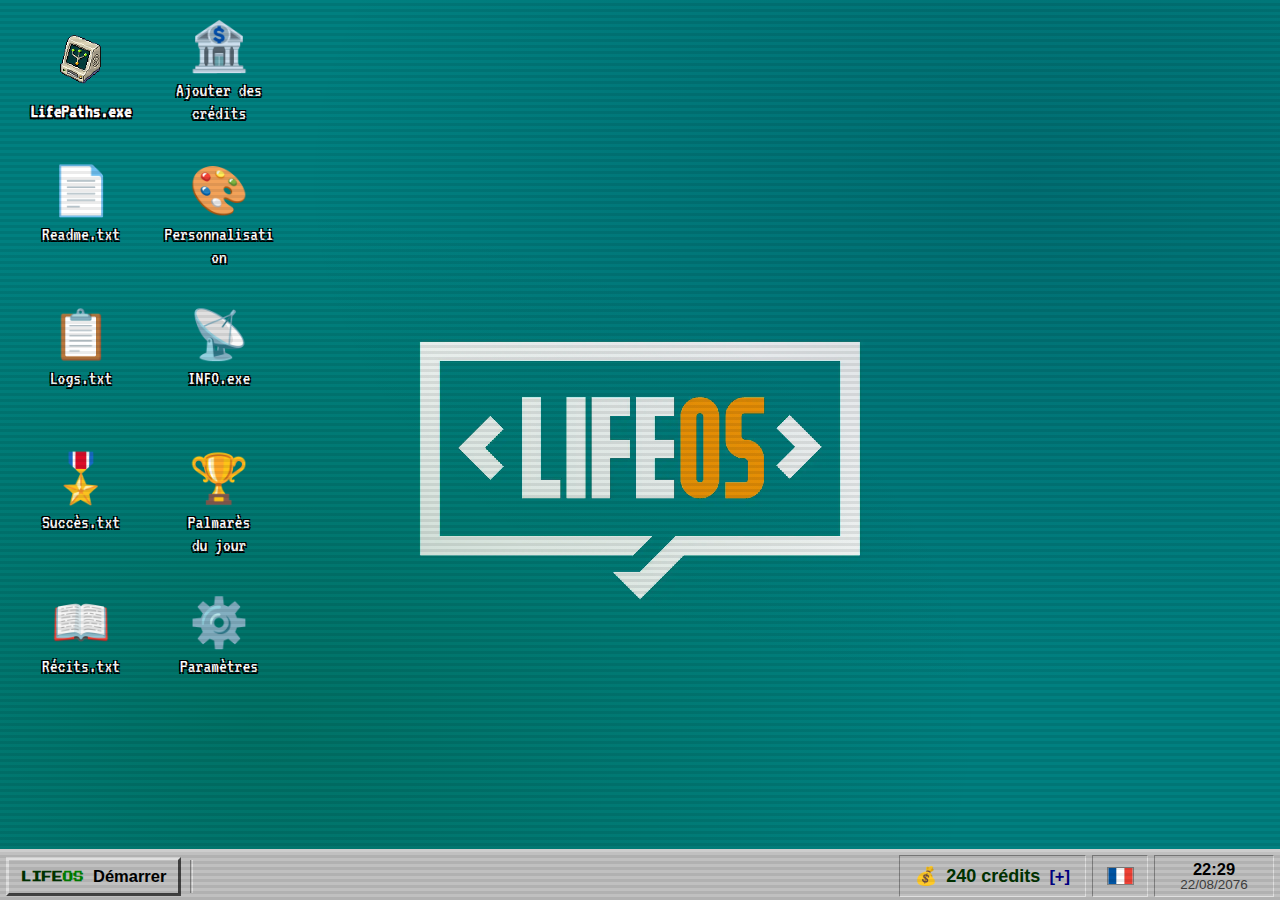
LifeOS
The interface that frames the game: a retro-futuristic operating system that "sells simulated existences." A satirical costume.
A plausible, everyday dystopia
2076 and beyond: broken climate, automated labour, megacorporations. The stakes stay human: money, health, dignity.
The Civic Index
An algorithmic score from 0 to 1000 that decides what's allowed: housing, healthcare, credit. Three castes (Off-Grid, Flux, Certified), partly inherited from one's parents and shaped by the player's own actions.
The Kairos (₭)
In the game's fiction, the euro was unofficially abandoned in 2059: lives are counted in Kairos.
Screenshots
Logos & visuals
Artwork: Alex "Primis" Beddelem.

Editorial reproduction is authorized for articles, reviews, interviews and videos about LifePaths. Usage terms and credits.
Wallpapers: the default theme, plus the 5 unlocked by the game's achievements.



How LifePaths uses generative AI
Generative AI
- Classifies the plausibility of the attempted action (routine, plausible, risky, improbable, impossible).
- Proposes a coherence modifier (-30 to +30), with a stated reason.
- Writes the narration for events, dialogue and consequences (inside the tier the engine imposes).
- Generates the childhood, starting traits and life dreams at the start of a playthrough.
- Rewrites a compressed life summary over the years.
The LifePaths engine
- Rolls the actual hundred-sided die.
- Computes the final score and success tier (7 tiers, from critical failure to critical success).
- Applies every mechanical consequence (stats, money, Civic Index, criminal record).
- Decides death (health at zero, old age, a court verdict).
- Runs the credit economy, saves, achievements and the game's rules.
Diegetic generative imagery
The in-game news portal INFO.exe (the OMNI·INFO feed, its fictional ad banners and article visuals) uses AI-generated images. That's a deliberate diegetic choice: this synthetic content stands in for the advertising and information flow of a 2076 world saturated with artificial corporate content, and its synthetic nature is part of what it's saying.
Team & credits
LifePaths is developed solo by Antoine Cottenier. The logo and five unlockable wallpapers were made by independent illustrator Alex "Primis" Beddelem. Some diegetic OMNI·INFO visuals are AI-generated.
Antoine Cottenier
Game design, development, narrative systems, LifeOS and overall direction.
Alex « Primis » Beddelem
LifePaths logo, and 5 of the wallpapers unlocked by the game's achievements. Behance ↗
For creators & streamers
LifePaths plays well on video and stream: the dice roll is always on screen, decisions can be put to chat vote, every playthrough produces different twists, and the end screen sums up a whole life as a shareable card.
There's no formal creator programme yet — write to contact@lifepaths.io to discuss one.
Contact
Press, creators, partnerships:
contact@lifepaths.io · lifepaths.io
